
KAKIRI – Students and the administration of Kakiri Islamic Primary School have joined the rest of the country to mark World Environment Day 2026, launching a localized campaign to demonstrate practical grassroots solutions for environmental preservation.
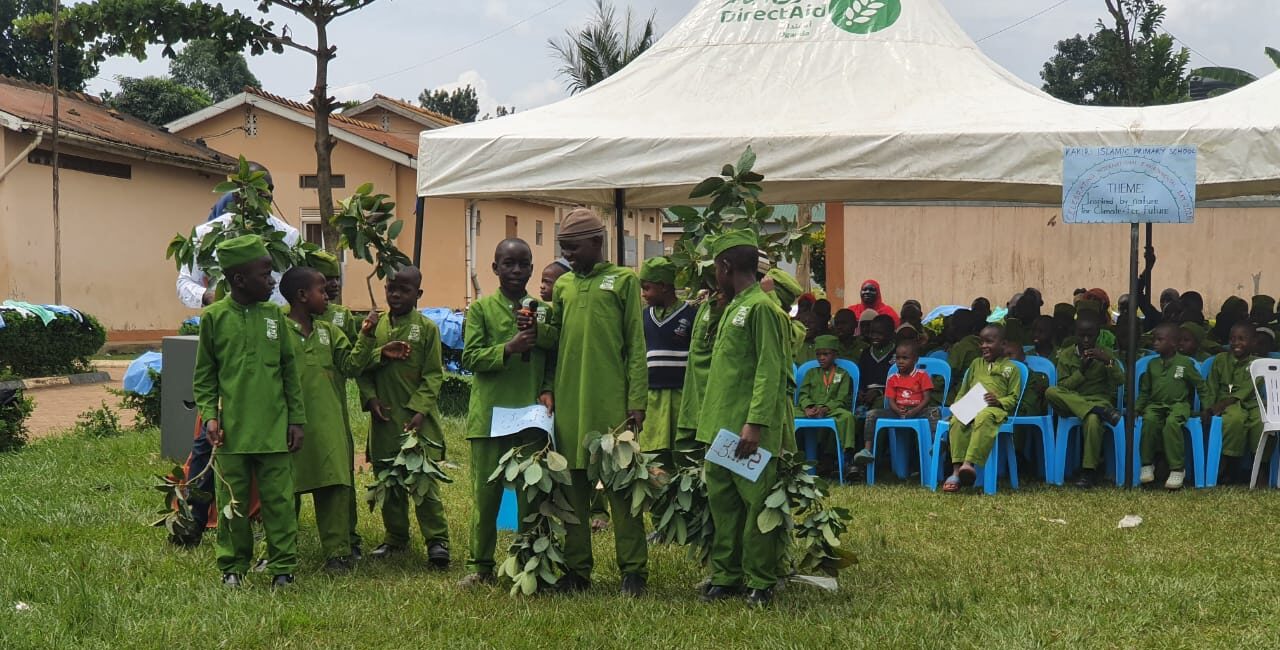
The colorful celebrations were held under the national theme, “Climate Action Begins with You: Act Now,” which complements the global directive, “Inspired by Nature. For Climate. For Our Future.”
The event highlighted the vital role that educational institutions and young citizens play in combating the pressing challenges of deforestation, plastic pollution, and climate change in their immediate communities.

Speaking to the congregation, the Headteacher of Kakiri Islamic Primary School, Mr. Mukwaya Swaib, challenged the learners to look at environmental conservation not as a one-day event, but as a lifelong, everyday obligation.
Mr. Mukwaya emphasized that the youth hold the key to turning the tide against environmental degradation, noting that small, consistent actions at school and at home can create a massive national impact.
“It is your collective and individual duty to preserve and protect the environment at all times,” Mr. Mukwaya told the attentive students. “The trees we cut, the plastics we litter, and the wetlands we degrade directly affect our future. True climate action must begin with how you behave today.”
To give immediate meaning to the national theme, the students led various exhibitions demonstrating sustainable environmental management. Through poems, matching drills, and short skits, the learners showcased the dangers of deforestation and presented practical methods for waste segregation and tree nurturing.

The school administration also rolled out an internal tree-planting initiative, tasking different student cohorts with planting and caring for saplings within the campus grounds to foster a practical culture of conservation.
The celebrations at Kakiri Islamic Primary School come at a time when environmental experts across Uganda are calling for urgent interventions to restore degraded forest cover and combat increasingly unpredictable weather patterns that threaten agricultural livelihoods.
We are so grateful for such wonderful presentations